PROJECT 02 — FULL STACK
RepairHub
An electronics repair-shop management concept — customers, devices, repair tickets, technicians, parts and invoices, tracked through one workflow.
OVERVIEW
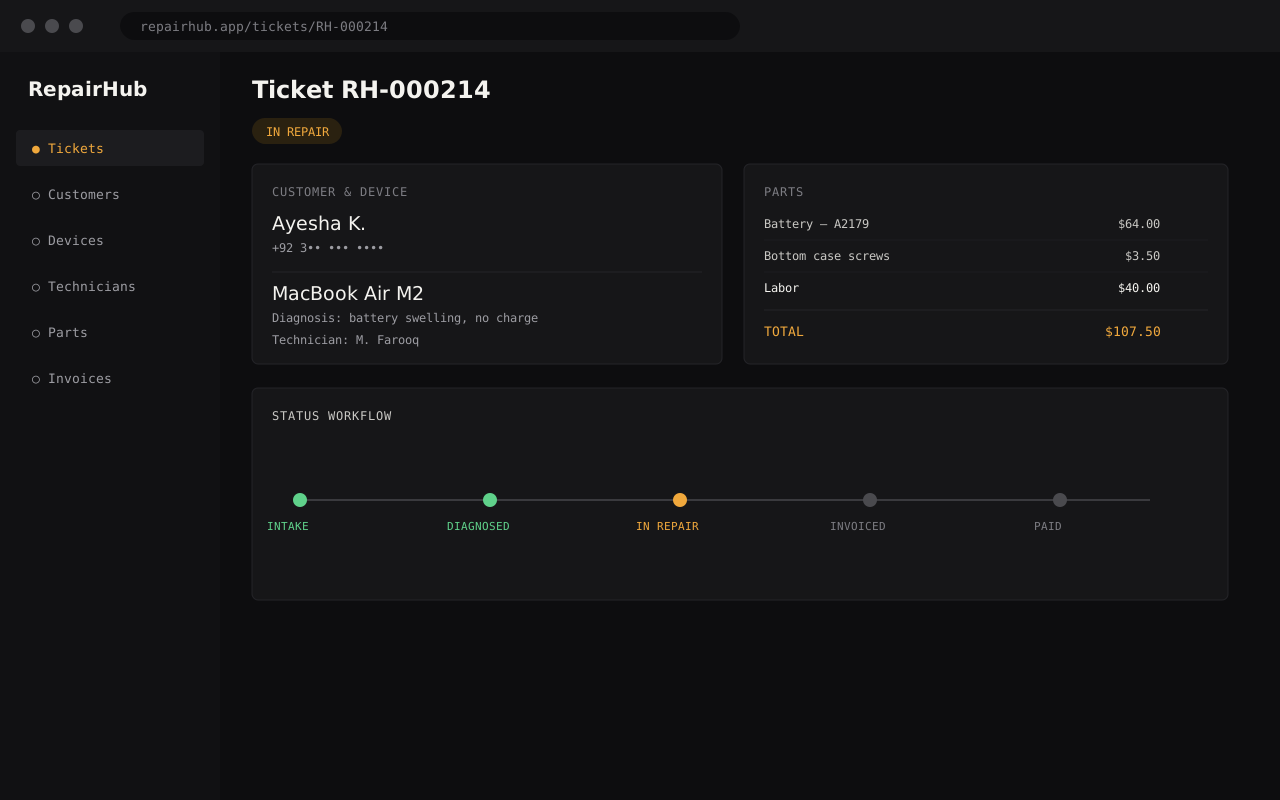
RepairHub is a management system concept for an electronics repair shop, designed around the full lifecycle of a repair: a customer brings in a device, a ticket is opened, a technician diagnoses the fault, parts are assigned, the repair happens, and an invoice is raised and paid.
The goal was a system that mirrors how a repair shop actually operates day to day, rather than a generic CRUD app with repair-shop labels on it.
THE IDEA
FEATURES
→Customer and device management
→Repair ticket creation and status tracking
→Technician assignment
→Parts tracking against a repair
→Invoice generation
→Payment tracking
→End-to-end workflow from intake to payment
TECHNOLOGY
ARCHITECTURE
The system is modelled around the repair workflow itself: Customer and Device sit at the top, a RepairTicket ties a device to a diagnosis and an assigned Technician, Parts are tracked against a ticket, and an Invoice and Payment close the loop.
Status tracking runs through the ticket at every stage, so the state of a repair — from intake to invoiced — is always visible rather than inferred.
CHALLENGES
WHAT I LEARNED
RepairHub's source and workflow docs are on GitHub.
VIEW ON GITHUB ↗