PROJECT 01 — FULL STACK
Health Tracker
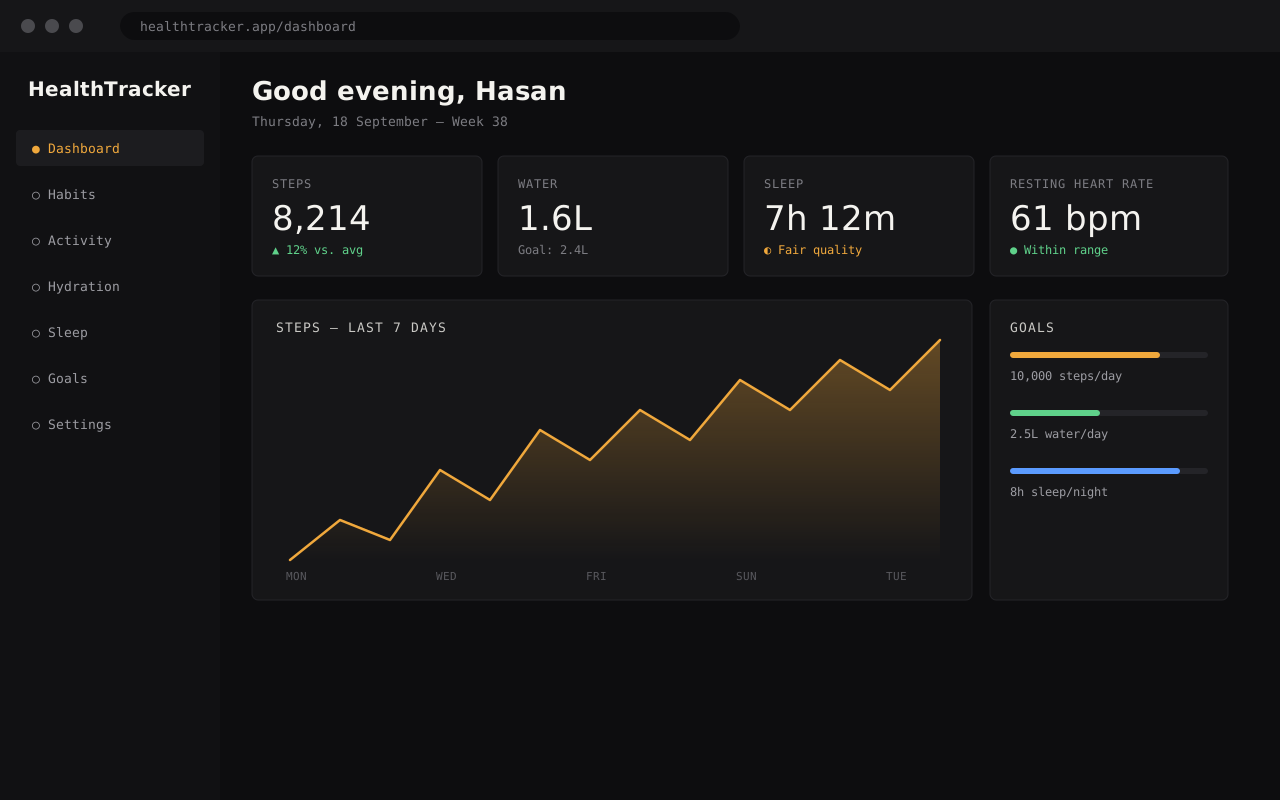
A Django application for tracking daily steps, water intake, sleep, resting heart rate, goals and habits — built as a proper V1 rather than a demo.
OVERVIEW
Health Tracker is a Django application built around a simple idea: most habit and health trackers either do too little or try to do everything at once. This one focuses on a defined V1 scope — habits, health metrics, goals and reminders — done properly, with room to extend later.
The backend is built with Django and Django REST Framework, running on SQLite in development and designed to be PostgreSQL-compatible in production. The frontend uses Django templates with vanilla JavaScript and Chart.js for the statistics views, so there's no separate frontend build step to manage.
THE IDEA
FEATURES
→Daily step, water, sleep and resting heart-rate tracking
→Habit tracking with streaks
→Personal goals with progress tracking
→Age/weight-based recommended targets instead of flat defaults
→In-browser accelerometer step counter (start/stop tracking)
→Hourly water-reminder toast with quick-log, plus email-based reminders
→Statistics views built with Chart.js
→Full authentication: registration, login, profile, password change
TECHNOLOGY
ARCHITECTURE
The app is split into focused Django apps — accounts, habits, health, goals, reminders and dashboard — instead of one large monolith app, which keeps each domain's models, views and templates easy to find and extend.
Settings are environment-driven so the same codebase runs on SQLite locally and PostgreSQL in production without code changes, and the build follows a phased spec so each piece is verified working before the next one is added.
CHALLENGES
WHAT I LEARNED
Source code and further documentation for Health Tracker are on GitHub.
VIEW ON GITHUB ↗